
Blog
7 Obscure Nintendo DS RPGs That Collectors Are Sleeping On in 2026

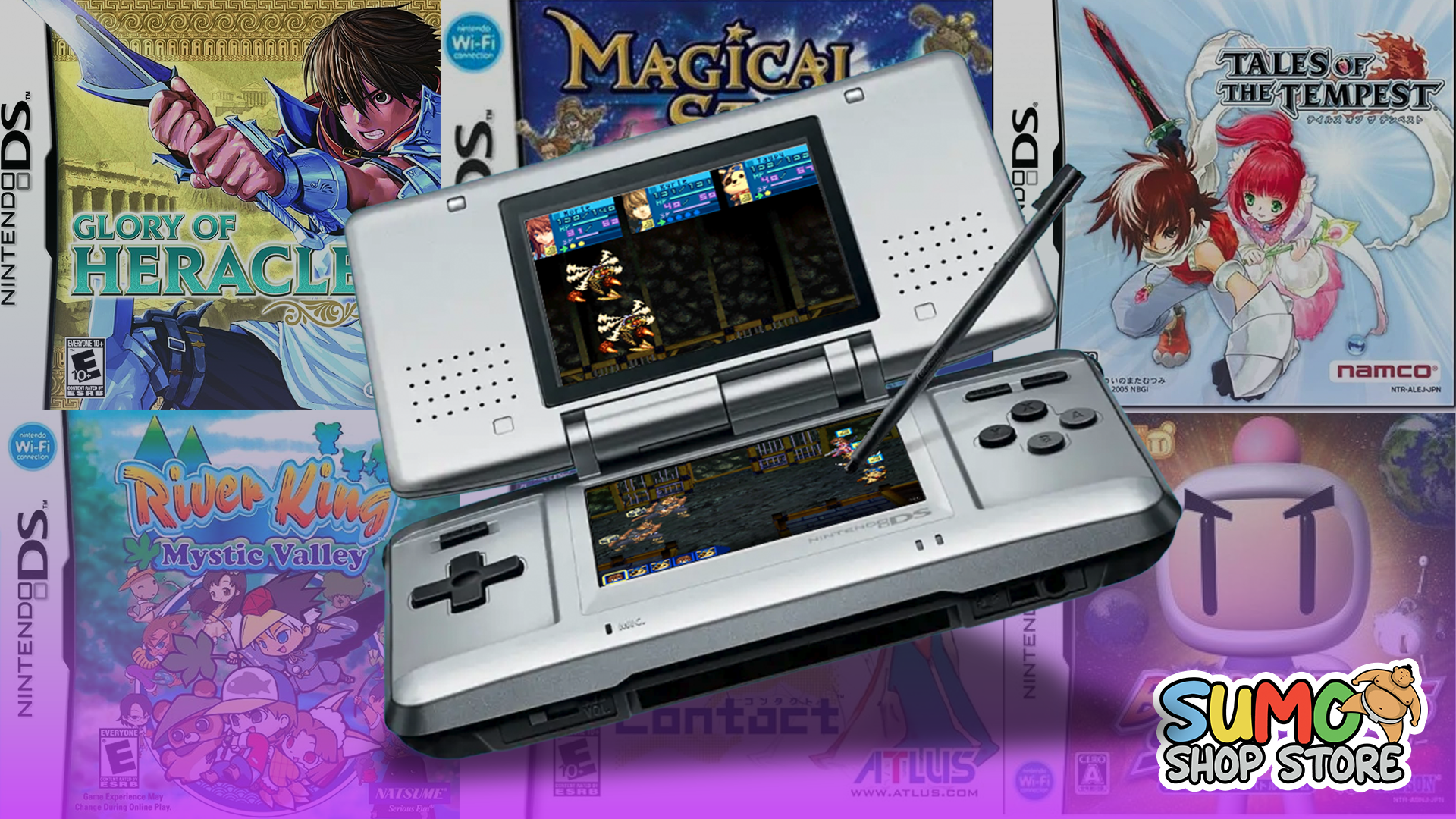
The Nintendo DS had one of the most experimental RPG libraries in handheld history, and somehow 90% of collectors completely ignore it. Look, I get it—when you think DS RPGs, you think Pokemon, Dragon Quest, maybe Final Fantasy. But there’s this whole underground scene of weird, innovative RPGs that pushed the dual screens and stylus in ways that’ll blow your mind.
Hey, it’s Marco, and after testing probably hundreds of DS units over the years here at SumoShopStore, I’ve played through more obscure DS RPGs than I care to count. These seven games prove the DS was way more than a Pokemon machine—it was a playground for developers who wanted to break every RPG rule in the book.
If you’re wondering what the best obscure DS RPGs are worth hunting down in 2026, these seven experimental gems showcase everything that made the platform special.
Table of Contents
- Obscure DS RPGs at a Glance
- Why These DS RPGs Got Overlooked
- Glory of Heracles — Greek Mythology Done Right
- Tales of the Tempest — The Black Sheep Goes English
- River King — Fishing Meets RPG Perfectly
- Bomberman Story DS — Action RPG Done Right
- Magical Starsign — Stylus Combat with Depth
- Contact — The Most Experimental RPG on DS
- Sands of Destruction — Anime Adaptation with Xenogears DNA
- What Collectors Need to Know in 2026
- The Honest Assessment
- Where to Pick Up Nintendo DS Systems in 2026
- Frequently Asked Questions
- Are these DS RPGs actually worth playing in 2026?
- How much do these obscure DS RPGs cost now?
- Do I need a DS Lite or will the original DS work fine?
- Can I play Tales of the Tempest in English without knowing Japanese?
- Which of these games should I start with?
- Are any of these games getting modern ports or remasters?
- How rare are complete-in-box copies of these games?
Obscure DS RPGs at a Glance
- Glory of Heracles — Greek mythology meets strategic grid-based positioning
- Tales of the Tempest — Japan-exclusive “black sheep” now playable in English
- River King — Fishing RPG hybrid where you catch 40+ species to save your sister
- Bomberman Story DS — Action RPG that merges classic bombing with experience points
- Magical Starsign — Stylus-controlled combat with elemental strategy depth
- Contact — Experimental auto-battle system that breaks every RPG convention
- Sands of Destruction — Anime adaptation with Xenogears-style flurry combat
Why These DS RPGs Got Overlooked
Here’s the thing about the DS RPG scene—Nintendo’s marketing push was all about Brain Age and Nintendogs. The experimental RPGs got buried under casual game hype, and most collectors moved straight from Game Boy Advance to hunting for 3DS titles without exploring what the DS actually offered.
The dual screens and stylus opened up possibilities that developers are still trying to figure out in 2026. Some of these games feel like prototypes for mechanics we’re just now seeing perfected. Others are so weird they could only exist in that specific moment when handheld developers were throwing everything at the wall to see what stuck.
And I’m not gonna lie—some of these experiments didn’t land. But the ones that worked? They’re absolutely worth tracking down, especially since complete-in-box copies are still reasonable compared to the insane Game Boy Advance market we’re dealing with now.
Glory of Heracles — Greek Mythology Done Right
Glory of Heracles is criminally underrated, and it’s one of those RPGs that does everything quietly and competently without making a big deal about it. You’re following Heracles—or at least you think you are—through a mystery that unfolds across the Greek islands. Yeah, it’s got the amnesia trope, but the way it handles Greek mythology feels authentic rather than surface-level.


Glory of Heracles
What makes this one special is the 2×4 grid battle system. Your party of four can be positioned in front and back rows, with melee fighters up front and ranged attackers in back. It sounds simple, but it adds this layer of tactical thinking that most traditional JRPGs completely skip. You’re not just selecting attacks—you’re positioning your team for maximum effectiveness.
The story unfolds as you explore each island by boat, and while it’s linear, each new area brings genuine surprises. The cast of NPCs actually matters to the plot, which is rarer than it should be in RPGs. If you’re a fan of old-school turn-based combat with just enough innovation to keep things interesting, this one’s worth hunting down.
Tales of the Tempest — The Black Sheep Goes English
Tales of the Tempest is the weird middle child of the Tales series that never left Japan—until the fan translation community got their hands on it. Now it’s playable in English, and honestly? It’s a solid entry point for anyone intimidated by the massive Tales games.


Tales of the Tempest
The story follows Kais, a half-beast kid being hunted in a world still recovering from the Beast Wars. It’s darker than most DS RPGs, and the three-plane battle system gives fights more strategic depth than you’d expect. Instead of fighting on a single plane like other Tales games, you’re managing positioning across three different layers.
Here’s where it gets complicated though—the touchscreen combat can devolve into mindless tapping if you let it. During easier fights, you can just tap enemies to death. But the difficult battles force you to actually use strategy, switch party members, and think about elemental weaknesses. It’s short for a Tales game, but there’s enough side content to flesh things out.
If you want to play this one, you’ll need either a Japanese cart with a flashcart setup for the translation, or you’ll need to go the emulation route. Original carts are getting pricey as imports, but it’s worth experiencing if you’re curious about the experimental phase of the Tales series.
River King — Fishing Meets RPG Perfectly
River King takes the novel concept of mixing fishing with RPG progression and actually makes it work. You’re a kid trying to save your sister from a deadly disease, and the only cure involves catching a legendary Guardian Fish. It’s simple on paper, but the execution creates this addictive loop that kept me playing way longer than expected.


River King: Mystic Valley
There are over 40 different fish species to catch, each requiring specific bait, lures, or rods. What makes it more than just a fishing simulator is the predator system—other creatures will try to steal your catches, leading to turn-based battles that let you level up and improve your combat stats.
The world exploration feels like a traditional RPG, with villages, NPCs offering clues and trades, and that constant sense of progression as you upgrade your equipment. Each fish you catch can be traded for gold, which buys better gear, which lets you catch bigger fish. It’s that classic “one more turn” gameplay loop that great RPGs nail.
Don’t sleep on this one if you see it. The fishing mechanics are way more engaging than they sound, and the RPG elements give it lasting power that pure fishing games lack.
Bomberman Story DS — Action RPG Done Right
Bomberman Story DS proves that the Bomberman RPG spinoffs are consistently underrated. The story’s aimed at younger players—you’re working for the Justice Department investigating galactic kidnappings—but the gameplay systems are surprisingly deep.


Bomberman Story DS
What sets this apart from other action RPGs is how it merges classic Bomberman mechanics with experience points and stat progression. You’ve got six different bomb types, each with unique properties, and your bombing skills actually improve as you level up. It creates this satisfying feedback loop where you’re getting better at both the strategic bombing and the character progression.
The dungeons are well-designed, with puzzles that require you to think about bomb placement and timing rather than just blasting everything in sight. Boss fights especially shine here—they demand you understand your bomb types and use them strategically rather than button mashing your way through.
If you enjoyed any of the Game Boy Bomberman RPGs, this one’s a natural evolution that takes advantage of the DS’s dual screens for inventory management and map display.
Magical Starsign — Stylus Combat with Depth
Magical Starsign is one of those games that could only exist on the DS, and it uses the stylus in ways that actually enhance the combat rather than feeling gimmicky. The core mechanic involves tapping characters during attacks and defense to boost damage or reduce incoming damage, but there’s real timing and skill involved.


Magical Starsign
The elemental strategy system runs deeper than most RPGs attempt. It’s not just “fire beats ice”—there are complex interactions between different magical schools, and managing these relationships becomes crucial during boss fights. The stylus controls feel natural once you get used to them, and they add this tactile element to combat that makes every battle feel more engaging.
The art style hits that sweet spot between cute and weird that a lot of DS games nailed. Characters are memorable without being obnoxious, and the world design has this dreamlike quality that fits the magical theme perfectly.
Your mileage may vary on the stylus-heavy combat, but if you’re looking for something that really uses the DS hardware in creative ways, this one’s worth tracking down.
Contact — The Most Experimental RPG on DS
Contact has one of the most unique battle systems I’ve ever encountered in an RPG, and I’m still not sure if it’s brilliant or completely insane. Your character Terry auto-attacks during battles, and you influence the outcome by switching between different “professions” that change his behavior and stats.


Contact
Instead of traditional leveling, your stats increase based on specific actions you perform. Use swords a lot? Your sword skill improves. Take damage? Your defense slowly builds up. It’s this organic progression system that rewards how you actually play rather than grinding for arbitrary experience points.
The auto-battle system has potential to feel dull during easier encounters, but it allows for this weird strategic layer where you’re managing Terry’s behavior rather than directly controlling every action. It’s definitely not for everyone—some people will find it too hands-off, while others will appreciate the experimental approach.
This is the kind of game that could only happen on a platform where developers felt free to completely break conventions. Whether it works for you depends on how much you enjoy RPGs that challenge your expectations about how the genre should function.
Sands of Destruction — Anime Adaptation with Xenogears DNA
Sands of Destruction adapts an anime series and manages to create a solid RPG experience with combat that feels inspired by Xenogears. The turn-based battles use a “flurry” versus “blow” attack system where you’re choosing between multiple quick hits or single powerful strikes.


Sands of Destruction
The story deals with a world where humans are oppressed by beastmen, and your party is trying to either save or destroy the world—hence the title. It’s heavier subject matter than most DS RPGs tackle, and the characters have genuine depth beyond their anime archetypes.
Combat encounters require you to think about attack timing and enemy weaknesses, and the flurry/blow system creates interesting tactical decisions. Do you go for chip damage and status effects, or save up for devastating single attacks? Boss fights especially reward players who understand these mechanics.
If you enjoyed Xenogears or similar RPGs with philosophical themes and complex combat systems, this one scratches a similar itch on a handheld.
What Collectors Need to Know in 2026
Here’s something most people don’t know about collecting DS RPGs—the region differences actually matter more than you’d think. Tales of the Tempest requires either a Japanese system or flashcart setup for the fan translation. River King had different localizations that affect availability. And some of these games had extremely limited print runs.


The DS Lite is absolutely the way to go for playing these games. The brighter screens make a huge difference for games like Magical Starsign that rely on visual clarity for their stylus mechanics. I’ve tested dozens of both models over the years, and the Lite’s screen quality is night and day better for detailed RPG interfaces.
Complete-in-box copies of these games are still reasonable compared to the insane Game Boy Advance market, but they’re climbing steadily. Glory of Heracles and Contact especially are getting harder to find in good condition. If you’re hunting for these, check the cart pins carefully—DS games are more susceptible to connection issues than people realize.
Most of these games benefit from the dual-screen setup in ways that emulation can’t quite replicate. The inventory management, map displays, and touch controls really need the physical hardware to feel right.
The Honest Assessment
Let’s be real about these games—they’re experimental, which means some experiments work better than others. Contact’s auto-battle system isn’t for everyone. Tales of the Tempest’s touchscreen combat can feel shallow during easy encounters. Magical Starsign’s stylus controls might frustrate players who prefer traditional inputs.
But that experimental nature is also what makes them special. These developers were trying things that no one had attempted before, and some of the innovations still feel fresh in 2026. The DS was this perfect storm of new hardware capabilities and developer willingness to take risks.
If you’re looking for polished, traditional JRPGs, you might bounce off some of these. But if you want to see what happens when developers throw out the rulebook and try completely new approaches to RPG design, this is exactly where the DS library shines.
Your mileage will definitely vary based on how much you enjoy experimental mechanics versus proven formulas. But for collectors interested in gaming history and innovative design, these games represent some of the most creative period in handheld RPG development.
Where to Pick Up Nintendo DS Systems in 2026


If this deep dive has you thinking about hunting down these obscure RPGs, here’s the thing—you’re going to need reliable DS hardware to actually play them. The stylus controls are crucial for half these games, and a worn-out touch screen will ruin the experience completely.
Look, eBay’s a crapshoot for DS systems. You never know if the screens are scratched, if the hinges are loose, or if someone’s attempted a botched repair job. And with DS prices climbing every year, you don’t want to gamble on untested units.
Here at SumoShopStore, we test every single DS and DS Lite before it ships. Every button response, both screens, stylus accuracy, cart slot connections—if it doesn’t pass our testing, it doesn’t go out the door. We’ve probably put hundreds of these through their paces over the years.
What we offer:
- Fully tested and guaranteed units
- Wide selection of colors and special editions
- Free worldwide shipping
- Real customer support from people who actually collect this stuff
Check out:
- Nintendo DS – Available in Purple, Silver, Aqua Blue, Blue, Black, Pink and more colors
- Nintendo DS Lite – Available in Black Ice, Blue Ice, Clear Ice, Diamond/Pearl edition and 20+ other colors, with optional USB-C upgrade
If you’re looking for something specific or want to browse the full retro handheld collection, check out SumoShopStore.com.
Frequently Asked Questions
Are these DS RPGs actually worth playing in 2026?
Absolutely, but with caveats. Games like Glory of Heracles and River King hold up really well because their core mechanics are solid. The more experimental ones like Contact and Magical Starsign are fascinating from a design perspective but might frustrate players expecting traditional RPG experiences.
How much do these obscure DS RPGs cost now?
Complete-in-box copies range from $30-80 depending on the game and condition. Tales of the Tempest Japanese carts can hit $100+ since you need them for the fan translation. Still way more reasonable than rare Game Boy Advance RPGs, but prices are climbing steadily.
Do I need a DS Lite or will the original DS work fine?
The DS Lite is definitely worth the upgrade. The brighter screens make a huge difference for games with detailed interfaces, and the stylus controls feel more responsive. I’ve tested both extensively, and the Lite just provides a better experience for RPGs that rely heavily on touch controls.
Can I play Tales of the Tempest in English without knowing Japanese?
Yes, but you’ll need the fan translation patch applied to the ROM, which requires either a flashcart setup or emulation. The translation is solid and makes the game fully playable for English speakers. Just be aware that original Japanese carts are getting expensive.
Which of these games should I start with?
Glory of Heracles or River King are the best entry points. They’re the most polished and accessible while still showing off what made DS RPGs special. Save Contact and Magical Starsign for after you’re comfortable with the platform’s experimental nature.
Are any of these games getting modern ports or remasters?
None have been announced, and given their experimental nature and touch-screen dependencies, they’d be tough to port effectively. The DS hardware is really integral to how these games function, so physical carts on original hardware is likely the only way to experience them properly.
How rare are complete-in-box copies of these games?
They’re getting harder to find but aren’t impossibly rare yet. Contact and Glory of Heracles had decent print runs in North America. River King and some of the other titles were more limited. If you’re collecting, now’s better than waiting—complete copies are definitely trending upward in price.
These seven obscure DS RPGs prove that the platform’s library runs way deeper than most collectors realize. From Glory of Heracles’ strategic grid combat to Contact’s completely experimental auto-battle system, these games showcase a period when developers felt free to completely reimagine what handheld RPGs could be.
So if you’re wondering what obscure DS RPGs are worth hunting down in 2026, these experimental gems offer experiences you literally cannot get anywhere else. Some of the mechanics feel ahead of their time, others are fascinating dead ends, but all of them represent the creative peak of handheld RPG design.
What are your picks for underrated DS RPGs? Let us know in the comments.